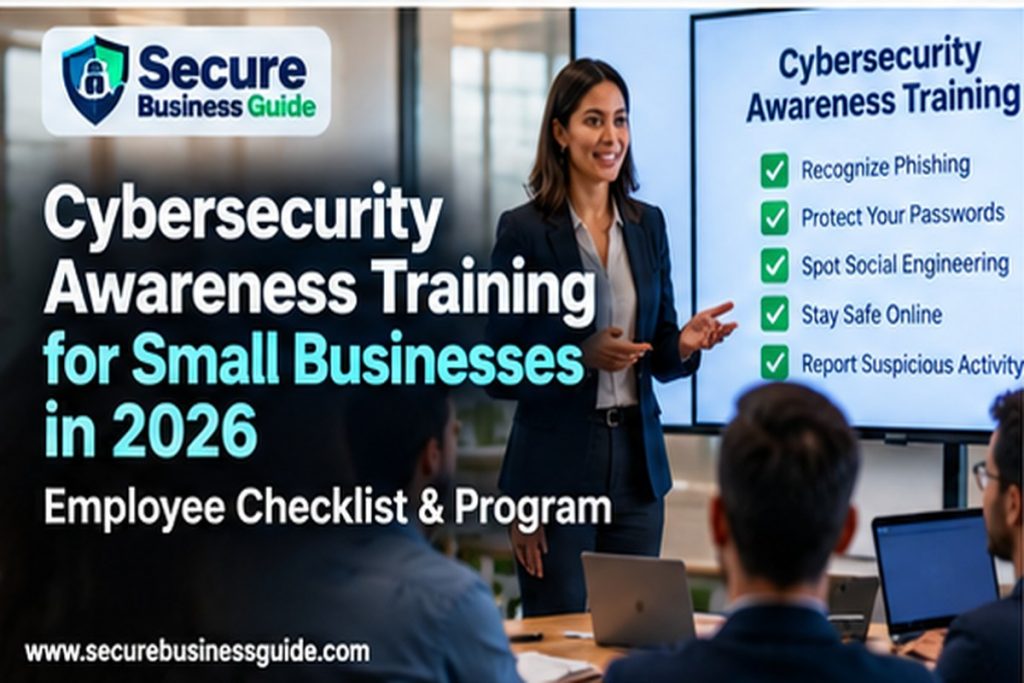
Cybersecurity awareness training for small business should teach employees how to make safer decisions during normal work, not simply require them to click through an annual presentation. In 2026, staff are exposed to phishing, business email compromise, AI-generated impersonation, fake login pages, QR-code scams, malicious attachments, MFA fatigue, credential theft and payment fraud across email, messaging apps, phones and collaboration tools.
Most importantly, a strong training program gives employees practical habits: slow down when a request creates urgency, verify sensitive requests through a second channel, use approved password and authentication tools, protect devices, report suspicious activity quickly and know what to do when they make a mistake.
This guide explains how a small business can build a professional security-awareness program without needing a large security department. It includes a training curriculum, employee checklist, phishing exercises, reporting workflow, metrics and a 12-month schedule.
Why Cybersecurity Awareness Training for Small Business Matters
However, technical controls are essential, but employees still make decisions that affect security every day. They receive invoices, approve password resets, open documents, access cloud services, handle customer information and communicate with suppliers.
The Federal Trade Commission advises small businesses to train staff on a regular schedule, update employees as risks change and teach them how to recognize phishing and other scams. In addition, the FTC recommends giving employees a clear way to report suspicious messages.
Therefore, training is most effective when it supports real business processes. For instance, a finance employee needs different examples from a marketing employee, and an administrator needs different training from a casual application user.
Top Human-Focused Cybersecurity Threats in 2026
Cybersecurity Awareness Training for Small Business: Business Email Compromise
Business email compromise uses impersonation, compromised mailboxes and social engineering to redirect payments or obtain sensitive information. Attackers may impersonate an executive, supplier, customer or employee.
Read our detailed guide to Business Email Compromise in 2026.
AI-Assisted Phishing and Impersonation
Meanwhile, generative AI can help attackers create polished messages, translate scams and tailor content to an organization or employee role. Consequently, poor grammar is no longer a reliable warning sign.
Instead, employees should focus on context: Was the request expected? Does it change normal payment details? Is the sender asking to bypass a process? Does the login link point to the correct domain?
Cybersecurity Awareness Training for Small Business: QR-Code Phishing
Likewise, QR codes can move users from a trusted corporate screen to a malicious page on a phone, where security controls may be weaker and URLs are harder to inspect. Training should teach staff not to scan unexpected QR codes simply because they appear in a familiar email or document.
MFA Fatigue and Authentication Social Engineering
For example, an employee may receive repeated login approval prompts after an attacker has obtained the password. The correct response is to deny the request, change the password through a trusted path and report the incident.
See our guide to Multi-Factor Authentication for Small Businesses in 2026.
Malicious Attachments and Cloud-Sharing Links
Attackers often use familiar file-sharing brands, PDF documents, archive files or cloud links. Employees should verify unexpected files and use approved company storage platforms.
Phone and Messaging Scams
In addition, cybersecurity training must include calls, SMS, WhatsApp and collaboration tools—not just email. Attackers may use a phone call to add pressure after sending a fraudulent email.
Cybersecurity Awareness Training for Small Business: Core Curriculum
Cybersecurity awareness training for small business works best when employees receive practical, repeated guidance that reflects the phishing, payment, identity and data risks they face in daily work.
Module 1: Passwords, Passkeys and Account Security
Employees should understand why password reuse is dangerous, how password managers help and when passkeys or hardware security keys are preferable.
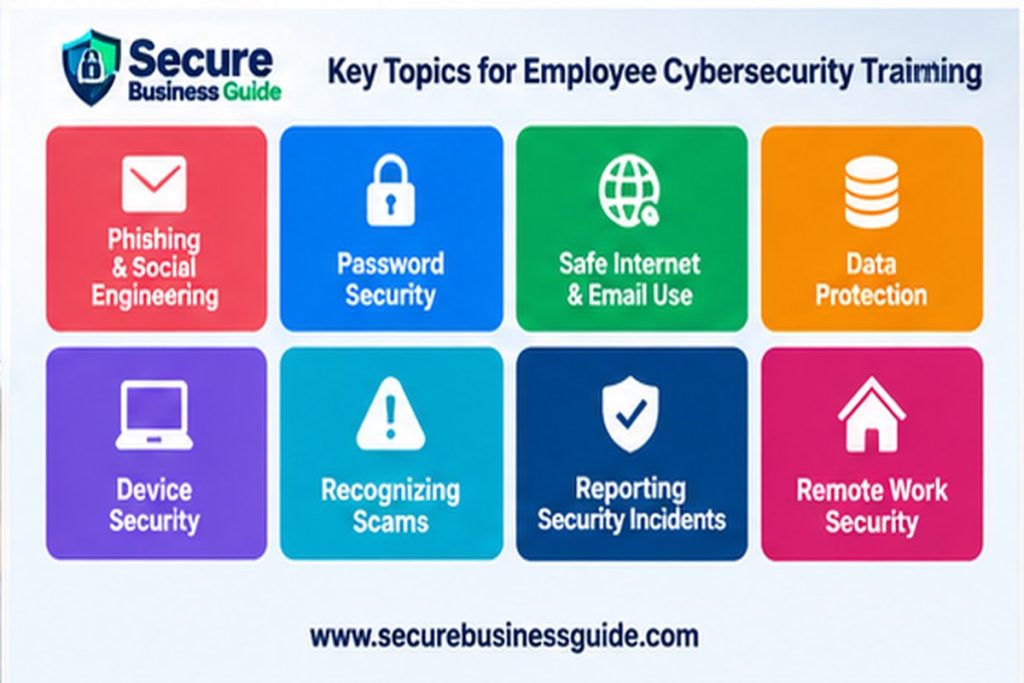
Teach users to:
- Use unique credentials for business accounts.
- Store business passwords in the company-approved password manager.
- Enable MFA where required.
- Never share authentication codes.
- Report unexpected login prompts.
- Protect recovery methods as carefully as passwords.
Cybersecurity Awareness Training for Small Business: Phishing and Social Engineering
Teach employees to evaluate the request rather than relying only on appearance. A professional-looking email can still be malicious.
Red flags include unexpected urgency, payment changes, unusual secrecy, new bank details, password-reset links, requests to disable security controls, unfamiliar login pages and attachments that do not match the conversation.
Module 3: Business Email Compromise
Therefore, finance, purchasing, payroll and leadership teams should receive deeper BEC training. The most important control is independent verification of sensitive changes.
For example, if a supplier requests new bank details by email, employees should verify the change using a known phone number or an approved supplier-management process—not the contact details inside the suspicious message.
Module 4: Safe Web and Cloud Use
Employees should learn to identify the real domain before entering credentials. Attackers frequently create domains that resemble Microsoft, Google, banks or suppliers.
Teach employees to access important services from bookmarks, password-manager entries or known company portals rather than from unexpected email links.
Module 5: Device Security
Training should cover screen locks, software updates, device encryption, safe Wi-Fi use, lost-device reporting and restrictions on unapproved software.
Module 6: Data Handling and Privacy
Similarly, employees need simple rules for storing, sharing and disposing of sensitive information. Training should reflect the actual types of data the business handles.
Cybersecurity Awareness Training for Small Business: Incident Reporting
Employees should know exactly how to report a suspicious email, lost device, unexpected MFA prompt, accidental data disclosure or suspected malware infection.
Use the Small Business Incident Response Plan for 2026 to connect employee reporting to a formal response process.
Cybersecurity Awareness Training for Small Business: Employee Checklist
Before Opening an Email or Message
- Check whether the request was expected.
- Look at the full sender address, not only the display name.
- Be cautious with urgency, secrecy and financial pressure.
- Verify unusual requests through another trusted channel.
- Do not assume good spelling means the message is legitimate.
Before Entering a Password
- Confirm the domain is correct.
- Use a saved bookmark or password-manager entry when possible.
- Do not follow unexpected “session expired” or “account locked” links without verification.
- Never enter a password into a page opened from an untrusted QR code.
When Using MFA
- Approve only authentication requests you initiated.
- Never read a code to another person.
- Report repeated unexpected prompts.
- Use passkeys or security keys when required for privileged accounts.
When Handling Payments
- Verify new bank details independently.
- Confirm unusual payment urgency with the requester.
- Follow dual-approval rules where available.
- Escalate suspicious instructions immediately.
When Working Remotely
- Use approved devices and secure connections.
- Avoid sensitive work on public or shared computers.
- Keep work devices physically secure.
- Report lost or stolen equipment immediately.
How Often Should Cybersecurity Awareness Training for Small Business Run?
However, annual training alone is too infrequent for a changing threat environment. A practical program combines structured training with shorter reminders and exercises throughout the year.
| Frequency | Activity |
|---|---|
| New hire | Core security orientation before or immediately after system access. |
| Quarterly | Short focused training on current threats and business processes. |
| Monthly | Brief security reminder, example scam or policy tip. |
| Periodically | Phishing simulation or tabletop exercise. |
| After an incident | Targeted lessons based on what happened. |
| When systems change | Training for new tools, authentication methods or workflows. |
Cybersecurity Awareness Training for Small Business: Phishing Simulations
For example, phishing simulations should improve behavior, not embarrass employees. The goal is to measure whether staff recognize risk, use verification processes and report suspicious messages.
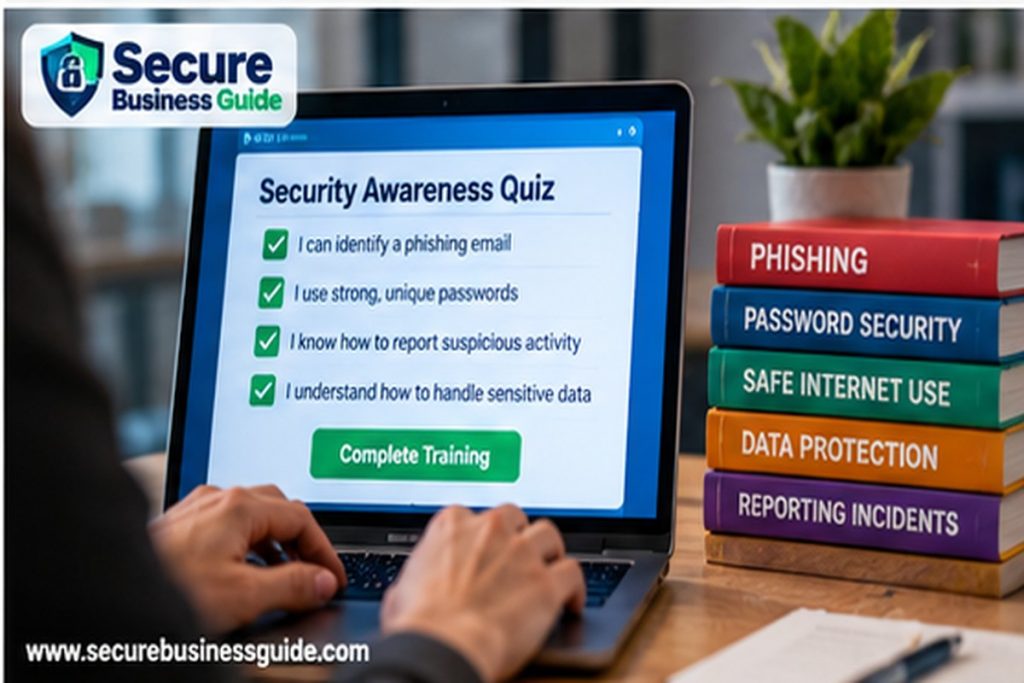
Use Realistic but Ethical Scenarios
Base simulations on business risks such as fake document shares, supplier invoices or password-reset notifications. Avoid manipulative themes involving personal emergencies, health scares or sensitive HR issues unless there is a compelling security reason and appropriate approval.
Measure Reporting, Not Just Clicking
However, a low click rate is useful, but fast reporting is often more valuable. An employee who reports a suspicious message quickly can help the company warn everyone else.
Provide Immediate Education
As a result, when someone interacts with a simulation, explain the indicators they missed. Keep the lesson short and specific.
Do Not Publish Individual Failure Lists
By contrast, public shaming discourages reporting and can damage security culture. Track repeated problems privately and provide additional coaching where necessary.
Cybersecurity Awareness Training for Small Business: Role-Based Training
Finance and Accounts Payable
Focus on BEC, invoice fraud, supplier bank changes, payroll diversion, executive impersonation and verification procedures.
Executives and Owners
Cover high-value impersonation, privileged access, travel security, secure approval workflows and the risk created by public information about leadership.
IT and Administrators
Include privileged access, phishing-resistant MFA, logging, change control, backups, incident response and secure recovery processes.
Marketing and Social Media
Cover account takeover, malicious direct messages, fake copyright notices, OAuth scams, credential phishing and brand impersonation.
Customer Support
Teach identity verification, safe handling of customer data and resistance to social engineering that attempts to bypass normal account recovery.
Cybersecurity Awareness Training for Small Business: Reporting Culture
Above all, employees should be able to report suspicious activity without fear of punishment for an honest mistake. If someone clicks a phishing link and reports it immediately, the business may still be able to contain the incident quickly.
Create a simple reporting process such as a “Report Phishing” button, dedicated security email, help-desk category or emergency phone number. Make sure employees know which method to use when normal email may itself be compromised.
Cybersecurity Awareness Training for Small Business: What to Do After a Phishing Click
- Tell the employee to stop interacting with the page.
- Determine whether credentials or MFA codes were entered.
- If credentials were exposed, reset them using a trusted device and path.
- Revoke active sessions and review authentication methods.
- Check mailbox rules and connected applications for cloud accounts.
- Inspect the device if a file was opened or software installed.
- Preserve the suspicious message and relevant logs.
- Follow the incident-response plan if compromise is suspected.
Security Awareness Metrics That Actually Matter
In addition, useful metrics should show whether risk is improving, not merely whether employees completed a course.
- Training completion rate.
- Phishing simulation reporting rate.
- Median time to report suspicious messages.
- Rate of repeat simulation failures.
- Percentage of users with MFA enabled.
- Number of real incidents first detected by employees.
- Time between employee report and security response.
- Number of policy exceptions involving unapproved software or file sharing.
Cybersecurity Awareness Training for Small Business: 12-Month Program
| Month | Focus |
|---|---|
| 1 | Core cybersecurity orientation and reporting procedures. |
| 2 | Phishing and fake login pages. |
| 3 | Password managers, MFA and passkeys. |
| 4 | Business email compromise and payment verification. |
| 5 | Safe remote work and device security. |
| 6 | Phishing simulation and coaching. |
| 7 | Data handling and privacy. |
| 8 | QR-code phishing, SMS and messaging scams. |
| 9 | Ransomware awareness and backup responsibilities. |
| 10 | AI-assisted scams and impersonation. |
| 11 | Incident reporting tabletop exercise. |
| 12 | Annual review, metrics and next-year improvements. |
How Leadership Should Support the Program
Ultimately, security awareness fails when leaders ignore the same rules they expect employees to follow. Executives should use strong authentication, follow payment verification processes and support employees who report suspicious activity.
Leadership should also make time for training and avoid rewarding risky shortcuts. If staff are pressured to process urgent payments without verification, the policy exists only on paper.
Cybersecurity Awareness Training for Small Business: Policy Template
A simple policy can state that all employees must complete security training at onboarding and on a recurring schedule; use approved authentication and password tools; follow verification procedures for sensitive requests; protect company devices and data; and report suspicious activity immediately.
The policy should also define who owns the program, how completion is tracked and what happens when someone repeatedly ignores required controls.
Frequently Asked Questions
Cybersecurity Awareness Training for Small Business: How Long Should Training Be?
Short, frequent training is usually easier to absorb than one long annual session. Core onboarding may take longer, while monthly or quarterly updates can be brief and focused.
Should small businesses run phishing simulations?
Yes, when they are used constructively. Simulations can help measure employee behavior, reporting speed and whether verification procedures are understood.
What topics are most important?
Phishing, business email compromise, account security, MFA, password managers, payment verification, device security, data handling and incident reporting are strong priorities for most small businesses.
Cybersecurity Awareness Training for Small Business: How Do We Train Employees About AI Scams?
Teach them not to rely on writing quality or voice familiarity. They should verify unusual financial or sensitive requests through a second trusted channel and follow established approval processes.
What should employees do if they make a security mistake?
Report it immediately. Fast reporting can dramatically improve the organization’s ability to contain an incident.
Final Takeaway
Cybersecurity awareness training should create repeatable habits, not just satisfy a compliance checkbox. Employees need to know how to recognize suspicious requests, verify sensitive actions, use secure authentication and report problems quickly.
The FTC recommends regular staff training and keeping employees updated as risks change. Build the program around the way your business actually works, measure reporting behavior, reinforce lessons throughout the year and connect training to your incident-response process.
Once cybersecurity and operational processes are strong, digital businesses can also improve their growth visibility with CBOOMARANK, including SEO, backlink and competitor analysis. See current options at CBOOMARANK pricing.